IV Care
26 min read
What Changes When the Nurse Comes to You
An ER nurse of 15 years on what mobile wellness care actually changes for patients — the honest version, with the evidence and its limits.

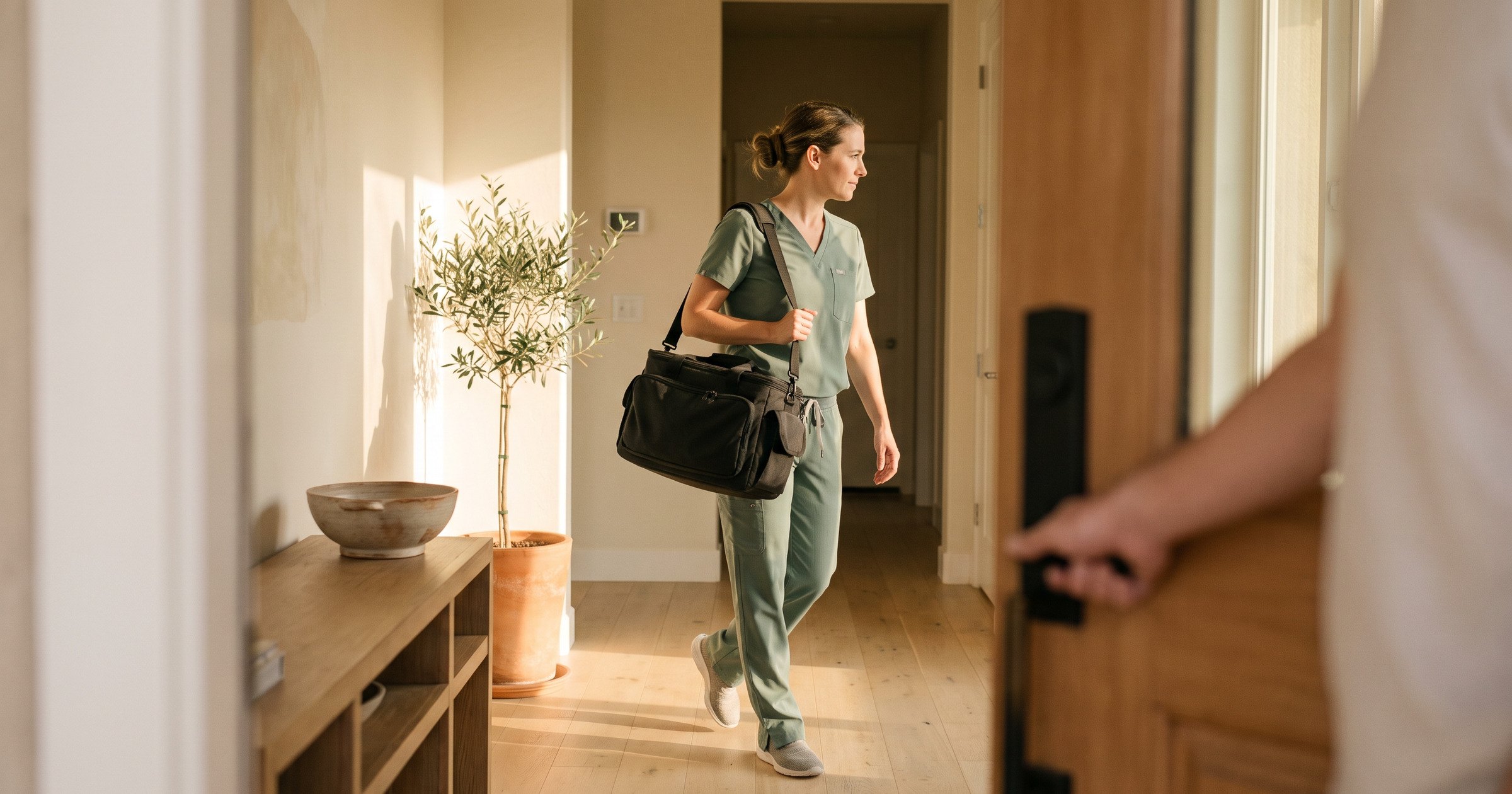
I spent fifteen years in an ER in Fresno. You learn a lot of things there, but the one that stuck with me had nothing to do with medicine. It was this: by the time somebody reached my bay, getting to me had already cost them something. A shift. A babysitter. Gas money. Two hours in a chair under fluorescent lights, rehearsing their symptoms so they could say it fast enough before the doctor moved on.
I now run RN operations for u-wellness, and I train every nurse who joins us. My job flipped. Instead of people coming to me, I go to them. I did not expect that to change the clinical picture much. It changes it a lot.
The part nobody puts in the chart
Transportation is not a footnote. A review of 61 studies in the Journal of Community Health found transportation barriers affecting anywhere from 3% to 67% of the populations studied, depending on the group — and in one clinic population, 51% of parents named transportation as the main reason they missed appointments.[1] Those are not people who don’t care about their health. Those are people whose car wouldn’t start.
When I drive to you, that whole category of failure disappears. You don’t no-show on your own kitchen.
What I can see in your kitchen that I can’t see in a clinic
This is the part I did not anticipate.
In an exam room, I get your report of your life. At your house, I get your life. The water bottle that’s still full at 4 p.m. The supplement shelf — eleven bottles, six expired, two duplicating each other. Whether you sleep with a TV on. The shift-work schedule taped to the fridge.
None of that is snooping. It’s assessment, and it makes the plan concrete instead of theoretical. Half of what I coach on a visit isn’t the drip at all — it’s the eleven bottles.
The evidence that care at home works is real, and I want to be precise about what it shows. A randomized trial at Brigham and Women’s found hospital-level care provided at home cut the direct cost of an episode by 38%, cut 30-day readmissions from 23% to 7%, and got patients moving — home patients spent 18% of the day lying down versus 55% for inpatients.[2] A 2024 Cochrane review of 20 trials and 3,100 patients found admission-avoidance hospital-at-home made little or no difference to mortality or readmission, but that satisfaction with care may improve — graded low-certainty, which is honest of them, and I’ll be honest too.[3]
Those are acute-care studies. We are not acute care. But they point at the same thing I see every day: people do better in their own space, and they like it more.
San Diego, a bride, and six bridesmaids
Best day I’ve had on this job.
A bride booked us for her bachelorette weekend in San Diego. Seven women — her and six bridesmaids — in a rental house with, generously, one working outlet per room and a coffee table that became my supply station.
A wellness day for seven people looks like triage before it looks like anything else. Everybody gets screened individually, because “we’re all doing the same thing” is not a clinical plan. Seven separate intakes, seven separate physician-approved plans, and all seven of them ended in an IV drip — but they were not the same drip, and that distinction is the entire job. The bride wanted to feel like herself on a day she’d been thinking about for a year, which is a completely legitimate thing to want.
I ran the room like a nurse, not like a party. Consents signed. Vitals. Screening questions asked one at a time, away from the group, because nobody discloses honestly in front of six friends. Then seven drips, one after another, while somebody’s playlist got progressively worse.
I’ve started IVs in a trauma bay with a helicopter landing outside. Seven simultaneous wellness plans in a vacation rental is the harder logistics problem — and the only one of the two where I got to watch people be genuinely happy.
Now the part where I tell you what we don’t know
I’d rather you trust me in five years than book me this week.
IV versus oral is a real pharmacologic difference, and narrower than the marketing suggests. The NIH work on vitamin C is the clean example: 1.25 g by mouth produced peak plasma levels around 135 µmol/L; the same dose intravenously produced about 885 µmol/L, because oral absorption is tightly regulated and IV bypasses that ceiling.[4] That is a measured phenomenon. What it does not prove is that higher plasma levels make a healthy person feel better. Two different claims, blurred constantly.
The IV-wellness outcome literature is thin. The best-known controlled trial of a classic IV micronutrient formula — the Myers' Cocktail, in fibromyalgia — found clinically meaningful improvement in the treatment group, a large placebo response, and no statistically significant difference between them.[5] It’s a small pilot in one condition: not evidence that drips do nothing, not evidence that they work. A shrug with error bars, and anyone who tells you otherwise is selling.
Hangovers. A BMJ systematic review of randomized trials concluded there is no compelling evidence that any conventional or complementary intervention prevents or treats hangover.[6] The physiology is also less about dehydration than people assume — studies looking for correlations between hangover severity and electrolytes, hormones, or dehydration markers like vasopressin didn’t find them; the strongest signal was immune-inflammatory.[7] Book us after a wedding weekend and I’ll happily rehydrate you, and you’ll probably feel better. I’m not going to tell you the bag cured your hangover.
Sleep. The meta-analysis on oral magnesium for insomnia found sleep onset about 17 minutes faster than placebo — graded low to very low quality across three small trials.[8] I mention magnesium to patients. I mention the 17 minutes and the “low quality” in the same breath.
And most people are not frankly deficient. CDC’s NHANES biomarker series, 1999 through 2023, shows deficiency prevalence for most vitamins is low and has barely moved in two decades — while excess vitamin D rose from under 1% to 8%, and to 16% among supplement users.[9] More isn’t the goal. The right amount is. That’s why we test, and why a physician signs the plan instead of a menu board.
What patients actually say
Real messages, from real patients, lightly trimmed only for length:
“Had the best sleep ever! It was amazing! Thank you.” — I.C.
“I’m impressed with my energy levels and sleep!” — I.C.
“Rest and recovery has been great since my IV session! Energy has improved overall, which has allowed my body and mind to perform at a high level as a professional bodybuilder and personal trainer.” — N.T.
“I definitely feel more energy throughout my day... and I’ve been sleeping better too.” — D.H.
Every patient who has rated a visit so far has given us five stars — eleven out of eleven. I’m not going to pretend that’s a thousand reviews. It’s eleven, we’re a young company, and I’d rather you know the real number than a rounded one. But every single one of them is real, and I was in most of those rooms.
How this actually works
Every plan is read and finalized by our medical director, Dr. Bahram Sohrabi, DO, a board-certified family physician. Not a template he signed off on once. Yours. An RN — me, or a nurse I trained — confirms the protocol at your door and administers it. We text at one hour and again the next morning, and what you tell us changes the next plan.
We come to homes, and we run hubs, with a physical clinic in the works. One-time visits and monthly membership are both options — current pricing lives on our pricing page. We’re a Central California company staffed by Central Californians, and Fresno, Clovis and the Valley are home.
This is wellness care, not treatment for any disease or condition. Nothing here is a diagnosis or a cure claim. If you’re having a medical emergency, call 911.
References
Syed ST, Gerber BS, Sharp LK. Traveling towards disease: transportation barriers to health care access. J Community Health. 2013;38(5):976–993. https://pmc.ncbi.nlm.nih.gov/articles/PMC4265215/
Levine DM, Ouchi K, Blanchfield B, et al. Hospital-level care at home for acutely ill adults: a randomized controlled trial. Ann Intern Med. 2020;172(2):77–85. https://pubmed.ncbi.nlm.nih.gov/31842232/
Edgar K, Iliffe S, Doll HA, et al. Admission avoidance hospital at home. Cochrane Database Syst Rev. 2024;3(3):CD007491. https://pmc.ncbi.nlm.nih.gov/articles/PMC10911897/
Padayatty SJ, Sun H, Wang Y, et al. Vitamin C pharmacokinetics: implications for oral and intravenous use. Ann Intern Med. 2004;140(7):533–537. https://pubmed.ncbi.nlm.nih.gov/15068981/
Ali A, Njike VY, Northrup V, et al. Intravenous micronutrient therapy (Myers' Cocktail) for fibromyalgia: a placebo-controlled pilot study. J Altern Complement Med. 2009;15(3):247–257. https://pmc.ncbi.nlm.nih.gov/articles/PMC2894814/
Pittler MH, Verster JC, Ernst E. Interventions for preventing or treating alcohol hangover: systematic review of randomised controlled trials. BMJ. 2005;331(7531):1515–1518. https://pmc.ncbi.nlm.nih.gov/articles/PMC1322250/
Penning R, van Nuland M, Fliervoet LA, Olivier B, Verster JC. The pathology of alcohol hangover. Curr Drug Abuse Rev. 2010;3(2):68–75. https://pubmed.ncbi.nlm.nih.gov/20712596/
Mah J, Pitre T. Oral magnesium supplementation for insomnia in older adults: a systematic review & meta-analysis. BMC Complement Med Ther. 2021;21(1):125. https://pmc.ncbi.nlm.nih.gov/articles/PMC8053283/
Pfeiffer CM, Sternberg MR, Powers CD, et al. The prevalence of nutritional imbalances in the US population over time: biomarker data from NHANES 1999–2000 through August 2021–August 2023. Curr Dev Nutr. 2026;10(5):107689. https://pmc.ncbi.nlm.nih.gov/articles/PMC13185987/
More Articles


